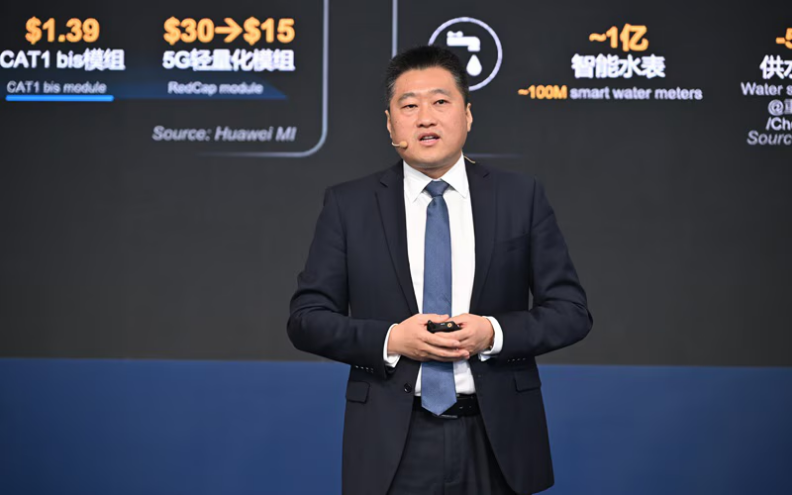
At the GSMA IoT Summit during Mobile World Congress (MWC) Shanghai 2025, Eric Zhao, Vice President and Chief Marketing Officer of Huawei Wireless Solution, delivered a keynote address titled “5G-A Powers All-Scenario IoT, Turbocharging a New AIoT Era for All.” In his speech, Zhao highlighted how the convergence of Artificial Intelligence (AI) and the Internet of Things (IoT) is ushering in an era of intelligent connectivity, transforming industries and everyday life.
According to Zhao, three fundamental pillars are accelerating this transformation: all-scenario IoT, ultra-broadband networks, and intelligent applications driven by industry-specific models. Together, these elements are enabling seamless connections across physical and digital environments, forming the foundation of what Huawei calls a fully intelligent AIoT ecosystem.
As AI becomes more deeply embedded into cellular IoT, intelligent applications such as autonomous vehicles and embodied AI robots are beginning to proliferate. Industries are integrating these capabilities across environments ranging from production lines to smart cities. This evolution is not only extending connectivity to previously isolated spaces, but also unlocking new use cases such as drone-based infrastructure inspections and responsive smart port logistics.
Zhao emphasized three key drivers of this transformation:
All-scenario IoT technologies like 5G RedCap and Ambient IoT, building on the foundation of NB-IoT, are enabling broader, more efficient device connectivity. These solutions support diverse applications, including real-time robotics and AI-powered quality inspections, while operating with low latency and power consumption.
Ultra-broadband 5G-Advanced (5G-A) networks offer enhanced capabilities such as Gbps uplink, ultra-low latency, and expansive coverage. These upgrades allow networks to handle large-scale data collection and immediate data transfers to the cloud for AI training and inference. The result is real-time decision-making and automation at the edge.
Intelligent applications, powered by domain-specific AI models, are already delivering measurable impact. For instance, a smart manufacturing facility in Guangdong, China, has deployed AI-enhanced 5G HD cameras to automate quality inspection, reducing repair rates by 20% and saving over CNY1 million annually.
As the commercial adoption of 5G-A continues to accelerate, Huawei is committed to collaborating with global carriers and industry stakeholders to develop converged AIoT solutions. Zhao concluded his keynote with a call to action: “We will continue to work with our partners to build a thriving AIoT ecosystem and promote the widespread development of cellular IoT, paving the way to a fully intelligent, connected world.”
MWC Shanghai 2025 took place from 18 to 20 June at the Shanghai New International Expo Center (SNIEC). Huawei’s latest innovations in 5G-A and AIoT were showcased in Hall N1.
To learn more, visit: https://carrier.huawei.com/en/events/mwcs2025