Tag: #WomenSafety

  • Milieu Insight Survey of 3,000 Women Explores Safety and Confidence Across Six Southeast Asian Capital Cities

    Milieu Insight Survey of 3,000 Women Explores Safety and Confidence Across Six Southeast Asian Capital Cities

    Milieu Insight has released a comprehensive regional study surveying 3,000 women across six Southeast Asian capital cities — Singapore, Bangkok, Hanoi, Jakarta, Kuala Lumpur and Manila — examining how safe women feel in daily life, the precautions they take, and how digital safety influences their participation at work and in public spaces. The findings reveal wide disparities across the region, highlighting both physical and digital vulnerabilities that shape women’s lived experiences.

    When measuring the proportion of women who feel “very safe” in their daily lives, Singapore ranked highest at 31%, followed by Hanoi (26%) and Jakarta (19%). Bangkok and Kuala Lumpur each recorded 9%, while Manila ranked lowest at 7%. However, perceived safety tells only part of the story. Across all six cities, large majorities of women reported modifying their routines due to safety concerns. In Kuala Lumpur, 82% of women have changed their behaviour — the highest in the region. Manila follows closely at 81%, with many avoiding certain hours or locations. Even in Singapore, 40% reported adjusting their routines, underscoring what researchers describe as a paradox: women may report feeling safe, yet still practice self-imposed restrictions.

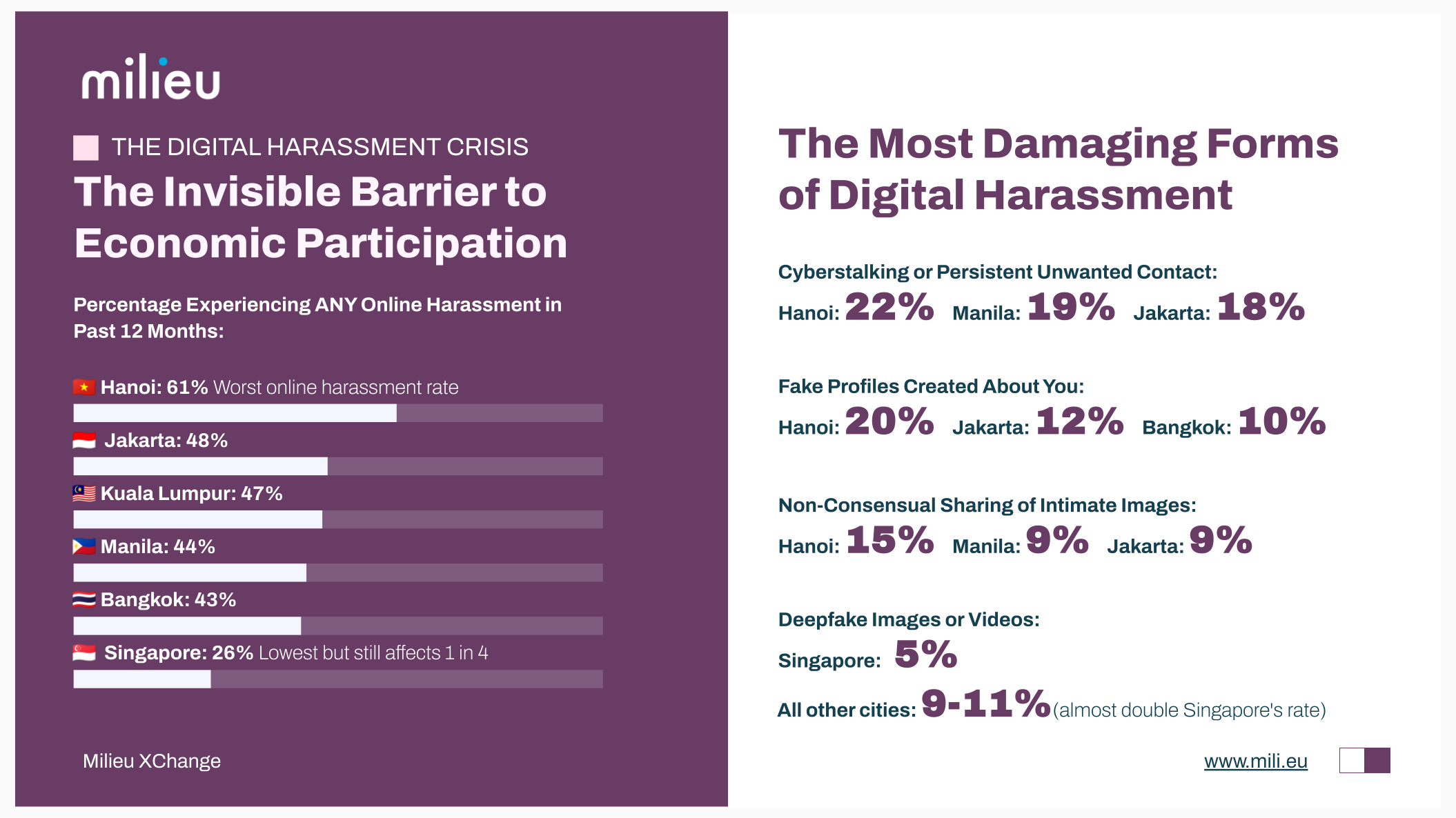
    The study also highlights digital harassment as a growing crisis. In Hanoi, 61% of women experienced at least one form of online harassment in the past year, including stalking, doxxing and impersonation. Jakarta reported 48%, Kuala Lumpur 47%, Manila 44%, Bangkok 43% and Singapore 26%. The professional and psychological consequences are significant. Across cities, women reported limiting what they post online, withdrawing from networking opportunities and experiencing anxiety or sleep disturbances. In Hanoi, 42% have stopped participating in public discussions altogether. Up to 31% of respondents across the region said they have considered leaving social media entirely, raising concerns about long-term economic participation, entrepreneurship and leadership visibility.

    Workplace challenges further compound these issues. Women reporting no workplace problems ranged from 31% in Singapore to just 18% in Hanoi. In Jakarta, 52% cited a lack of flexible work arrangements, while 43% faced caregiving responsibilities and safety concerns related to commuting or working late. Hanoi showed similar patterns, with 56% reporting caregiving pressures. Pay discrimination remains an issue, highest in Hanoi (21%) and followed by Singapore (15%) and Jakarta (13%). Safety concerns also restrict career progression, with many women unable to work late due to fears around commuting.

    Institutional trust varies sharply across the region. Women who “strongly agree” that city infrastructure supports their safety ranged from 23% in Hanoi, Jakarta and Bangkok to just 9% in Manila. Trust in government decision-making reflecting women’s needs was highest in Hanoi (21%) and Singapore (16%), while distrust was most pronounced in Manila (23%) and Bangkok (17%). Low trust correlates with underreporting of harassment, as many women believe reporting incidents will not lead to meaningful action or fear retaliation.

    According to Cindy Pang, Southeast Asia CEO at Milieu Insight, many women feel “safe” because they have learned to avoid risk — but avoidance is not freedom. The study underscores the need for coordinated efforts by governments, employers and digital platforms to create environments where women can participate fully in society, build careers and raise families without fear or restriction.