Tag: #SoutheastAsia

  • iCents Rangkul Kontrak dengan WXYD China, Pacu Solusi Penyejukan Pusat Data di Asia Tenggara

    iCents Rangkul Kontrak dengan WXYD China, Pacu Solusi Penyejukan Pusat Data di Asia Tenggara

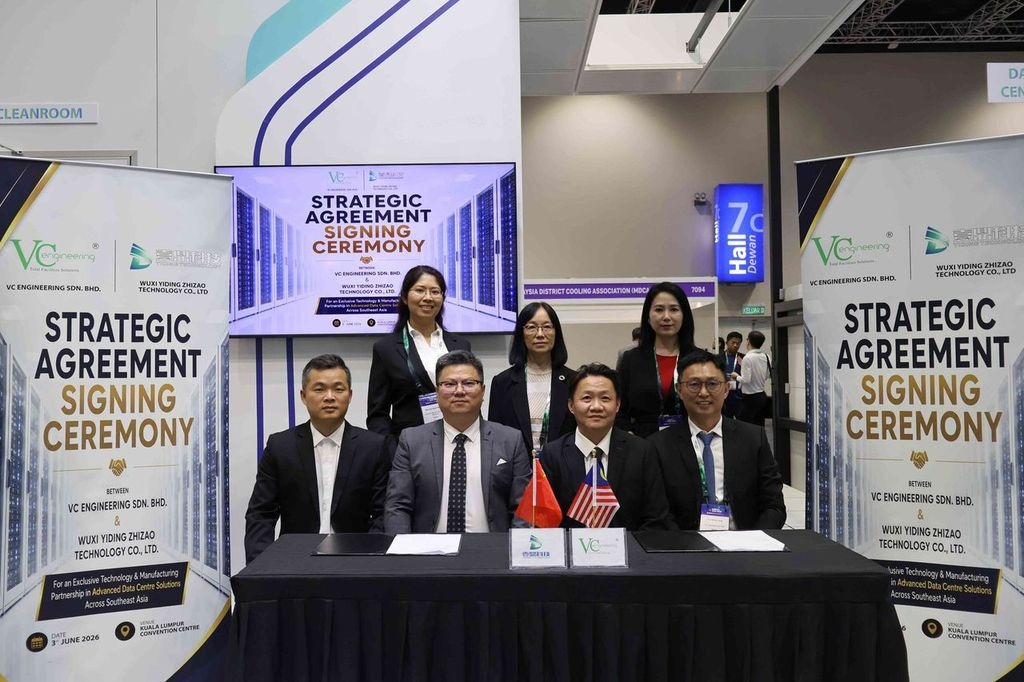
    iCents Group Holdings Berhad (iCents atau Kumpulan), penyedia perkhidmatan kejuruteraan khusus terkemuka, mengumumkan bahawa anak syarikat milik penuhnya, VC Engineering Sdn Bhd (VC Engineering), telah memeterai Perjanjian Kontrak strategik bersama Wuxi Yiding Zhizao Technology Co., Ltd. (WXYD) dari China. Perjanjian tersebut bertujuan untuk menjalinkan kerjasama rasmi dalam pembangunan, pemasaran, dan penyampaian sistem penyejukan modular pasang siap serta penyelesaian pengurusan terma bagi projek infrastruktur pusat data di seluruh rantau Asia Tenggara.

    WXYD merupakan entiti teknologi yang mempunyai kepakaran teras dalam pembangunan teknologi, integrasi sistem kawalan pintar, penyelesaian automasi perindustrian, dan perkhidmatan teknologi berkaitan di Republik Rakyat China. Menerusi kerangka perjanjian ini, WXYD akan membekalkan sokongan teknologi dan perkhidmatan kepakaran terma mereka untuk disepadukan dengan keupayaan pelaksanaan projek milik VC Engineering, sekali gus membolehkan kedua-dua pihak memanfaatkan unjuran pertumbuhan tinggi dalam sektor infrastruktur digital serantau.

    Pengarah Urusan iCents Group Holdings Berhad, Ir. Ts. Vincent Ong Mum Fei menyatakan bahawa pasaran semasa sedang menyaksikan lonjakan permintaan yang ketara terhadap Kecerdasan Buatan (AI), pengkomputeran awan, dan infrastruktur hiperskala. Sehubungan itu, beliau menegaskan bahawa penyelesaian pengurusan haba yang cekap adalah amat kritikal bagi menyokong kebolehpercayaan operasi dan kecekapan tenaga kemudahan tersebut. Langkah ini sekali gus memperkukuh penyertaan Kumpulan dalam sektor infrastruktur digital di samping membina keupayaan kejuruteraan khusus untuk kemudahan kritikal misi (mission-critical facilities).

    Menyentuh mengenai unjuran komersial, Pengarah Eksekutif iCents Group Holdings Berhad, Foo Siang Leng menambah bahawa sinergi antara keupayaan pelaksanaan projek Kumpulan dan kepakaran pengurusan terma WXYD akan mewujudkan platform komprehensif bagi memenuhi keperluan pelanggan yang beroperasi dalam persekitaran spesifikasi tinggi. Selain daripada kolaborasi dan pemindahan teknologi, perkongsian strategik ini turut membuka ruang kepada perkongsian kepakaran industri, pengukuhan hubungan pelanggan, dan penerokaan pasaran baharu di seluruh Asia Tenggara.

    Secara dasarnya, pelaksanaan kontrak ini akan memberikan tumpuan penuh kepada penyepaduan teknologi penyejukan dan penyelesaian infrastruktur modular, di samping memfasilitasi inisiatif pembangunan bersama untuk projek pusat data pada masa hadapan. Komitmen berterusan iCents dalam memperkukuh keupayaan kejuruteraan khusus ini dijangka akan membolehkan Kumpulan memanfaatkan peluang daripada pengembangan berterusan sektor pusat data dan pembuatan canggih, sekali gus menyokong objektif pertumbuhan dan nilai pemegang saham bagi jangka masa panjang.

  • Workers in Southeast Asia Worry More About AI Dependence Than Losing Jobs

    A new study by Milieu Insight, surveying 3,000 workers across six Southeast Asian markets—Singapore, Thailand, Malaysia, Indonesia, the Philippines, and Vietnam—reveals how employees perceive the risks associated with artificial intelligence (AI). Over-dependence on AI emerged as the top concern across all six markets, cited by 53% of respondents, ahead of privacy issues at 40% and job loss at 34%. While fears of job displacement remain notable, employees are increasingly questioning how AI might influence decision-making, critical thinking, and professional autonomy, highlighting unease over the potential erosion of human judgment and capabilities rather than the risk of outright replacement.

    Respondents represented a variety of organisation types, led by private large companies with 200 or more employees, followed by local SMEs and multinational corporations. They also span a diverse range of industries, including engineering, manufacturing, retail, and information technology. Across markets, the concern over AI dependency is highest in Indonesia at 61%, followed by Thailand at 55%, the Philippines at 53%, Vietnam at 50%, and Malaysia and Singapore at 49% each. In contrast, concerns about job loss rank consistently lower, suggesting that workers are more focused on maintaining their independent capabilities than fearing replacement.

    Looking ahead, 41% of respondents expect AI to assist them without replacing core tasks, using it to streamline routine work and improve efficiency. Over half (51%) said AI will help them save time on repetitive tasks, allowing them to focus on higher-value responsibilities. Meanwhile, 26% anticipate significant parts of their roles being automated, requiring adaptation to new methods, while 10% believe their jobs could be entirely replaced and another 10% expect AI to create new opportunities or responsibilities.

    Overall sentiment toward AI is largely optimistic. Forty-one percent describe themselves as somewhat optimistic, believing the benefits outweigh the risks, and 13% are very optimistic. Vietnam (66%) and Thailand (58%) record the highest optimism, while Singapore shows the highest combined pessimism at 15%. This optimism across emerging Southeast Asian markets reflects expectations that AI will drive productivity, digital innovation, and new economic opportunities.

    Despite strong interest in AI adoption, readiness gaps remain. Data security and privacy concerns are the most cited barrier, followed by lack of technical skills, cost, and employee resistance. Digital infrastructure gaps are more pronounced in Thailand and Indonesia than in Malaysia and Singapore, reflecting varying organisational maturity. Only a small proportion of respondents report that their organisations are fully prepared with strategies, resources, and training, while most describe themselves as only somewhat prepared. Active encouragement from employers to use AI is limited, ranging from 25% in Singapore to 38% in Vietnam.

    This gap between enthusiasm for AI and organisational readiness highlights a broader challenge in the region. While businesses recognise AI’s potential, many are still in the early stages of building governance, training, and infrastructure needed to support widespread adoption. Sundip Chahal, Group CEO of Milieu Insight, explained that workers are not just worried about being replaced but are concerned about becoming overly reliant on AI at the expense of judgment, capability, and independent thinking. He emphasised that while the workforce is open to AI, organisations must focus on providing the right training, guardrails, and disciplines to ensure it is used responsibly and effectively.