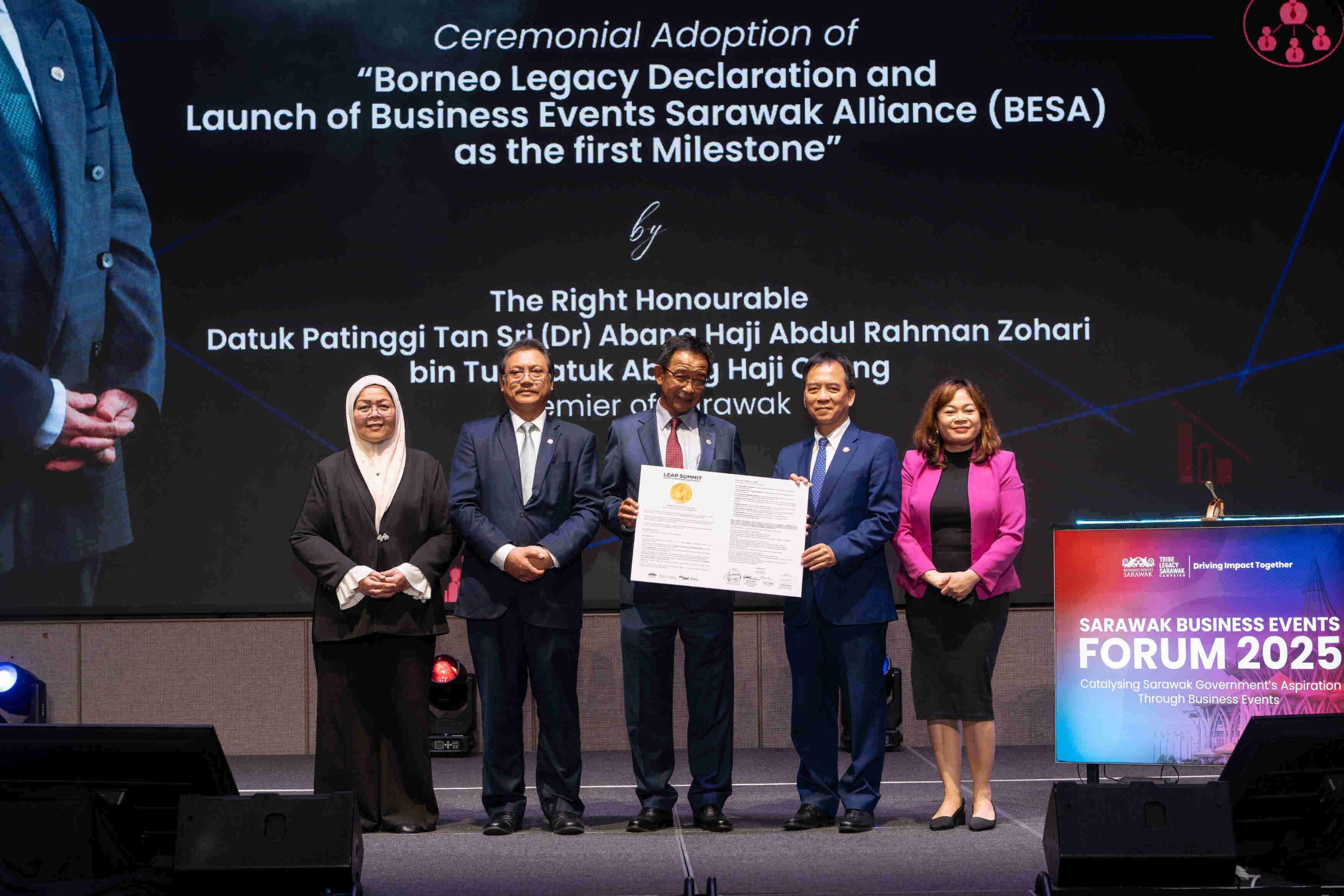
The Sarawak government has taken a major step in strengthening the business events sector with the official adoption of the Borneo Legacy Declaration and the launch of the Business Events Sarawak Alliance (BESA) during the Sarawak Business Events Forum. This initiative positions business events as strategic tools for delivering long-term policy outcomes and sustainable development across the state. The Borneo Legacy Declaration, formed during the Legacy Event Advocacy Policy (LEAP) Summit in October 2025, unites 36 policymakers and industry leaders from countries including Malaysia, Australia, Korea, the Philippines, the UK, and the US to champion legacy-driven events that foster sustainable economic growth.
BESA will serve as a collaborative platform connecting Sarawak’s government ministries with BESarawak to leverage business events for positive social, economic, and environmental outcomes aligned with the Post Covid-19 Development Strategy (PCDS) 2030. Starting in 2026, ministries will host and participate in national and international business events, prioritizing homegrown events through structured qualification processes. The platform also offers capacity-building programmes to enhance legacy impact advocacy among government agencies.

The Honorable Dato Sri Abdul Karim Rahman Hamzah, representing the Premier of Sarawak, highlighted the sector’s success, noting a 100% event bidding success rate and the growth of 72 homegrown events, including the Borneo International Water & Wastewater Exhibition & Conference and International Energy Week. Deputy State Secretary Datu Hii Chang Kee emphasized that the sector’s achievements result from strategic planning and a robust ecosystem, underscoring the importance of government-industry collaboration for future growth.
Amelia Roziman, CEO of BESarawak, hailed the government’s adoption of a legacy impact strategy as a landmark move, reinforcing Sarawak’s focus on sustainable and inclusive development in line with the state’s 13th Malaysia Plan (2026–2030). This development plan prioritizes high-impact investments in infrastructure, renewable energy, digitalization, human capital, and rural development, alongside strengthening key sectors such as manufacturing, agriculture, tourism, and services, ensuring long-term prosperity for the state.