Tag: #MilieuInsight

  • Workers in Southeast Asia Worry More About AI Dependence Than Losing Jobs

    A new study by Milieu Insight, surveying 3,000 workers across six Southeast Asian markets—Singapore, Thailand, Malaysia, Indonesia, the Philippines, and Vietnam—reveals how employees perceive the risks associated with artificial intelligence (AI). Over-dependence on AI emerged as the top concern across all six markets, cited by 53% of respondents, ahead of privacy issues at 40% and job loss at 34%. While fears of job displacement remain notable, employees are increasingly questioning how AI might influence decision-making, critical thinking, and professional autonomy, highlighting unease over the potential erosion of human judgment and capabilities rather than the risk of outright replacement.

    Respondents represented a variety of organisation types, led by private large companies with 200 or more employees, followed by local SMEs and multinational corporations. They also span a diverse range of industries, including engineering, manufacturing, retail, and information technology. Across markets, the concern over AI dependency is highest in Indonesia at 61%, followed by Thailand at 55%, the Philippines at 53%, Vietnam at 50%, and Malaysia and Singapore at 49% each. In contrast, concerns about job loss rank consistently lower, suggesting that workers are more focused on maintaining their independent capabilities than fearing replacement.

    Looking ahead, 41% of respondents expect AI to assist them without replacing core tasks, using it to streamline routine work and improve efficiency. Over half (51%) said AI will help them save time on repetitive tasks, allowing them to focus on higher-value responsibilities. Meanwhile, 26% anticipate significant parts of their roles being automated, requiring adaptation to new methods, while 10% believe their jobs could be entirely replaced and another 10% expect AI to create new opportunities or responsibilities.

    Overall sentiment toward AI is largely optimistic. Forty-one percent describe themselves as somewhat optimistic, believing the benefits outweigh the risks, and 13% are very optimistic. Vietnam (66%) and Thailand (58%) record the highest optimism, while Singapore shows the highest combined pessimism at 15%. This optimism across emerging Southeast Asian markets reflects expectations that AI will drive productivity, digital innovation, and new economic opportunities.

    Despite strong interest in AI adoption, readiness gaps remain. Data security and privacy concerns are the most cited barrier, followed by lack of technical skills, cost, and employee resistance. Digital infrastructure gaps are more pronounced in Thailand and Indonesia than in Malaysia and Singapore, reflecting varying organisational maturity. Only a small proportion of respondents report that their organisations are fully prepared with strategies, resources, and training, while most describe themselves as only somewhat prepared. Active encouragement from employers to use AI is limited, ranging from 25% in Singapore to 38% in Vietnam.

    This gap between enthusiasm for AI and organisational readiness highlights a broader challenge in the region. While businesses recognise AI’s potential, many are still in the early stages of building governance, training, and infrastructure needed to support widespread adoption. Sundip Chahal, Group CEO of Milieu Insight, explained that workers are not just worried about being replaced but are concerned about becoming overly reliant on AI at the expense of judgment, capability, and independent thinking. He emphasised that while the workforce is open to AI, organisations must focus on providing the right training, guardrails, and disciplines to ensure it is used responsibly and effectively.

  • Milieu Insight Survey of 3,000 Women Explores Safety and Confidence Across Six Southeast Asian Capital Cities

    Milieu Insight Survey of 3,000 Women Explores Safety and Confidence Across Six Southeast Asian Capital Cities

    Milieu Insight has released a comprehensive regional study surveying 3,000 women across six Southeast Asian capital cities — Singapore, Bangkok, Hanoi, Jakarta, Kuala Lumpur and Manila — examining how safe women feel in daily life, the precautions they take, and how digital safety influences their participation at work and in public spaces. The findings reveal wide disparities across the region, highlighting both physical and digital vulnerabilities that shape women’s lived experiences.

    When measuring the proportion of women who feel “very safe” in their daily lives, Singapore ranked highest at 31%, followed by Hanoi (26%) and Jakarta (19%). Bangkok and Kuala Lumpur each recorded 9%, while Manila ranked lowest at 7%. However, perceived safety tells only part of the story. Across all six cities, large majorities of women reported modifying their routines due to safety concerns. In Kuala Lumpur, 82% of women have changed their behaviour — the highest in the region. Manila follows closely at 81%, with many avoiding certain hours or locations. Even in Singapore, 40% reported adjusting their routines, underscoring what researchers describe as a paradox: women may report feeling safe, yet still practice self-imposed restrictions.

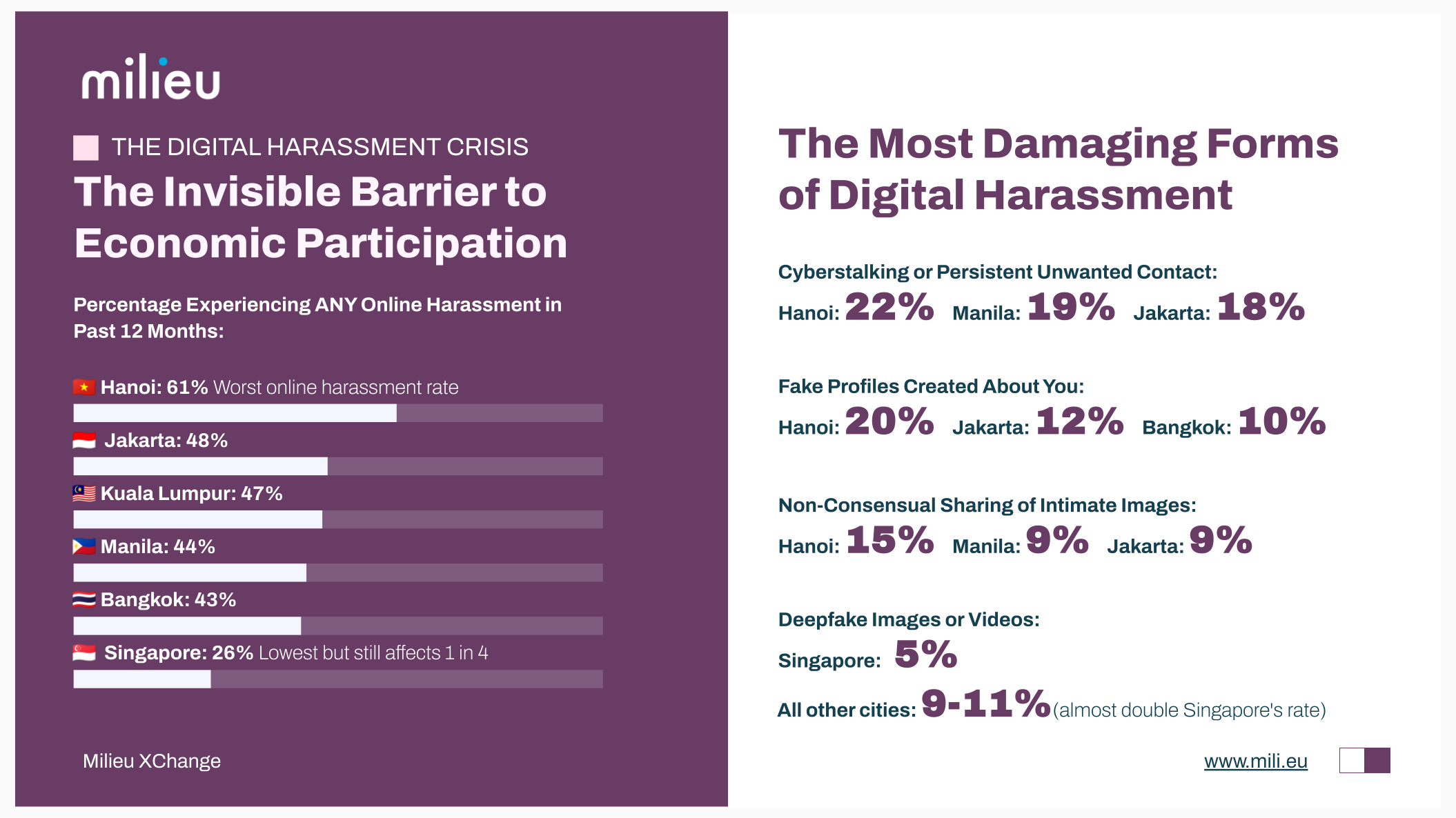
    The study also highlights digital harassment as a growing crisis. In Hanoi, 61% of women experienced at least one form of online harassment in the past year, including stalking, doxxing and impersonation. Jakarta reported 48%, Kuala Lumpur 47%, Manila 44%, Bangkok 43% and Singapore 26%. The professional and psychological consequences are significant. Across cities, women reported limiting what they post online, withdrawing from networking opportunities and experiencing anxiety or sleep disturbances. In Hanoi, 42% have stopped participating in public discussions altogether. Up to 31% of respondents across the region said they have considered leaving social media entirely, raising concerns about long-term economic participation, entrepreneurship and leadership visibility.

    Workplace challenges further compound these issues. Women reporting no workplace problems ranged from 31% in Singapore to just 18% in Hanoi. In Jakarta, 52% cited a lack of flexible work arrangements, while 43% faced caregiving responsibilities and safety concerns related to commuting or working late. Hanoi showed similar patterns, with 56% reporting caregiving pressures. Pay discrimination remains an issue, highest in Hanoi (21%) and followed by Singapore (15%) and Jakarta (13%). Safety concerns also restrict career progression, with many women unable to work late due to fears around commuting.

    Institutional trust varies sharply across the region. Women who “strongly agree” that city infrastructure supports their safety ranged from 23% in Hanoi, Jakarta and Bangkok to just 9% in Manila. Trust in government decision-making reflecting women’s needs was highest in Hanoi (21%) and Singapore (16%), while distrust was most pronounced in Manila (23%) and Bangkok (17%). Low trust correlates with underreporting of harassment, as many women believe reporting incidents will not lead to meaningful action or fear retaliation.

    According to Cindy Pang, Southeast Asia CEO at Milieu Insight, many women feel “safe” because they have learned to avoid risk — but avoidance is not freedom. The study underscores the need for coordinated efforts by governments, employers and digital platforms to create environments where women can participate fully in society, build careers and raise families without fear or restriction.