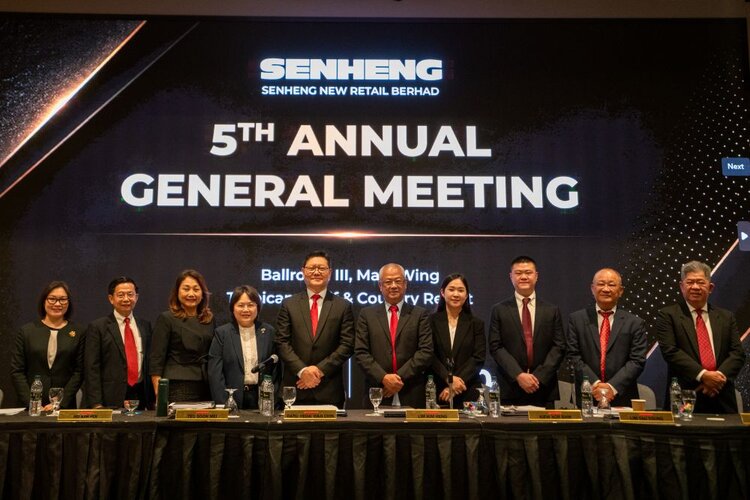
Senheng New Retail Berhad (“Senheng” atau “Kumpulan”), peruncit elektronik pengguna terbesar di Malaysia, mengumumkan bahawa semua resolusi yang dibentangkan pada Mesyuarat Agung Tahunan Kelima (AGM ke-5) telah diluluskan oleh para pemegang saham, sekali gus mencerminkan keyakinan berterusan terhadap kepimpinan dan hala tuju strategik syarikat.
Mesyuarat yang diadakan di Ballroom III, Sayap Utama, Tropicana Golf & Country Resort, Petaling Jaya itu turut menjadi platform bagi pihak pengurusan berkongsi prestasi kewangan, perkembangan operasi serta perancangan masa depan Kumpulan dengan para pemegang saham.
Pada AGM tersebut, Penyata Kewangan Beraudit bagi tahun kewangan berakhir 31 Disember 2025 bersama laporan Pengarah dan Juruaudit telah diterima. Para pemegang saham turut meluluskan semua resolusi termasuk pemilihan semula Pengarah, pelantikan semula BDO PLT sebagai Juruaudit dan kuasa kepada Pengarah untuk menerbitkan saham mengikut Akta Syarikat 2016.
Kelulusan turut merangkumi pembaharuan mandat sedia ada serta mandat baharu bagi transaksi pihak berkaitan berulang yang bersifat hasil atau perdagangan bagi memastikan operasi perniagaan dapat diteruskan secara cekap dan telus.
Pemilihan semula Lim Kim Heng, Lim Kim Chieng, Oh Keng Leng dan Lam Swee Kim sebagai Pengarah memperkukuhkan lagi kesinambungan kepimpinan Lembaga Pengarah dalam mengemudi Kumpulan menghadapi cabaran industri yang semakin dinamik.
Dato’ Yeow Wah Chin berkata, sokongan padu daripada pemegang saham memberikan keyakinan kepada Kumpulan untuk terus memperkukuhkan asas perniagaan, mempertingkat kecekapan operasi serta mewujudkan nilai jangka panjang kepada para pemegang saham.
Lim Kim Heng pula berkata, Senheng akan terus memperkasakan model Point-Based Economy melalui ekosistem S-Coin bagi meningkatkan kesetiaan pelanggan, memperluaskan penglibatan pengguna serta mengukuhkan prestasi perniagaan omnichannel.
Beliau turut menjelaskan bahawa model tersebut direka untuk meningkatkan nilai pelanggan sepanjang hayat, menggalakkan penebusan ganjaran secara lebih berstruktur serta memperkukuhkan permintaan menerusi saluran fizikal dan digital.
Melangkah ke hadapan, Senheng akan terus memberi tumpuan kepada pertumbuhan mampan melalui pelaksanaan strategi yang berdisiplin, pengurusan modal yang berhemat serta inovasi berterusan dalam pengalaman pelanggan.
Berikut versi yang lebih santai, mudah dibaca dan tidak terlalu baku untuk gaya portal berita teknologi:
HONOR hari ini mengumumkan jualan rasmi HONOR MagicPad 4 di seluruh negara, iaitu tablet paling canggih yang pernah dihasilkan oleh jenama itu setakat ini. Hadir dengan reka bentuk yang nipis dan ringan, keupayaan multitugas yang lebih pintar serta pengalaman Dwi-OS Android dan Linux yang baharu, MagicPad 4 direka untuk membantu pengguna bekerja, belajar, berkarya dan meneroka idea dengan lebih mudah di mana sahaja.
Seiring perubahan gaya kerja moden yang semakin fleksibel, termasuk kerja jarak jauh, pembelajaran hibrid dan penggunaan AI yang semakin meluas, ramai pengguna kini mahukan peranti yang mampu menawarkan prestasi tinggi tanpa mengorbankan mobiliti. HONOR MagicPad 4 tampil memenuhi keperluan tersebut dengan menggabungkan kemudahan sebuah tablet dan keupayaan produktiviti seperti komputer dalam satu peranti.
Pelanggan kini boleh mendapatkan HONOR MagicPad 4 di semua HONOR Experience Store seluruh negara serta menerusi platform rasmi seperti HONOR.com, Shopee, Lazada dan TikTok Shop.
MagicPad 4 hadir dalam dua pilihan konfigurasi. Varian 16GB RAM + 512GB ditawarkan pada harga RM3,999 dalam warna Grey. Pakej ini turut didatangkan bersama Smart Touch Keyboard, Magic Pencil 4s dan pelan Jaminan Kualiti Tanpa Risau selama dua tahun. Dengan rebat segera RM400 untuk tempoh terhad, harga akhir menjadi RM3,599 bersama manfaat pelancaran bernilai sehingga RM1,617.
Bagi pengguna yang mahukan pilihan lebih mampu milik, varian 12GB RAM + 256GB ditawarkan pada harga RM3,399 dalam pilihan warna Grey dan White. Varian eksklusif dalam talian ini turut disertakan Smart Keyboard, Magic Pencil 4s dan pelan Jaminan Kualiti Tanpa Risau selama dua tahun. Selepas rebat segera RM400, ia boleh dimiliki pada harga RM2,999 dengan manfaat keseluruhan bernilai sehingga RM1,517.
Apa yang menjadikan HONOR MagicPad 4 berbeza adalah pengalaman Dwi-OS Android dan Linux yang pertama seumpamanya dalam dunia tablet. Pengguna boleh bertukar antara Android untuk kegunaan harian seperti bekerja, belajar, hiburan dan komunikasi, manakala mod LinuxLab pula direka khas untuk pembangunan perisian, ujian aplikasi, penggunaan AI dan tugasan teknikal yang lebih kompleks.
LinuxLab menyokong sistem operasi Ubuntu dan Debian yang dibangunkan menggunakan seni bina berbekas atau containerized bagi memastikan sistem kekal stabil dan selamat. Semua aplikasi, pakej dan tetapan yang dipasang akan kekal tersedia walaupun selepas peranti dimulakan semula. Pengguna juga boleh mengakses fail penting melalui direktori khas yang boleh dicapai terus menggunakan pengurus fail Android.
Salah satu ciri yang menarik perhatian ialah sokongan kepada penggunaan ejen AI menerusi OpenClaw dalam LinuxLab. Dengan keupayaan ini, pengguna boleh meneroka pelbagai aliran kerja berasaskan AI secara terus daripada tablet mereka. Sama ada untuk mengurus maklumat, mengautomasikan tugasan berulang atau mencuba teknologi AI terkini, semuanya boleh dilakukan dengan lebih mudah.
Sebagai contoh, seorang pelajar boleh mengikuti kelas dalam talian menggunakan Android sambil menjalankan tugasan AI dalam LinuxLab untuk menjana nota, menyusun bahan rujukan atau menghasilkan ringkasan pembelajaran. Pendekatan ini menjadikan teknologi AI lebih mudah diakses dalam bentuk peranti mudah alih.
LinuxLab juga sesuai digunakan oleh pembangun perisian dan pengguna teknikal. Ia menyokong pelbagai tugasan seperti pembangunan Python dan Node.js, pembangunan aplikasi Android, penulisan skrip, automasi serta ujian perisian. Pengguna turut boleh mengakses Bash, command line Linux dan pelbagai alatan pembangunan secara terus daripada tablet.
Bagi memudahkan kerja pembangunan, LinuxLab turut menyokong aplikasi popular seperti Visual Studio Code, Cursor dan Claude Code. Ini membolehkan pengguna menulis kod, melakukan debugging dan mengurus projek dari mana-mana lokasi tanpa memerlukan komputer riba.
Selain pembangunan perisian, HONOR turut bekerjasama dengan WPS Office untuk membawa pengalaman produktiviti setaraf PC ke dalam MagicPad 4. Pengguna boleh mengurus dokumen, spreadsheet dan pembentangan menggunakan antaramuka yang lebih lengkap dan mesra desktop. Aplikasi ini dijangka mula tersedia kepada pengguna pada Julai ini.
Untuk pencipta kandungan pula, HONOR MagicPad 4 menyokong aplikasi CapCut Pad yang menawarkan pengalaman penyuntingan video lebih profesional. Dengan ruang kerja yang lebih luas, sistem timeline yang lebih fleksibel dan keupayaan multitugas yang lebih baik, pengguna boleh menghasilkan kandungan dengan lebih efisien.
Bagi melengkapkan pengalaman produktiviti, MagicPad 4 hadir dengan Mode PC yang menyokong sehingga 20 tetingkap dibuka serentak. Pengguna boleh mengendalikan pelbagai aplikasi, dokumen dan pelayar web pada masa yang sama tanpa mengganggu aliran kerja mereka. Digabungkan dengan sistem pengurusan fail seperti komputer, pengalaman penggunaan menjadi lebih lancar dan praktikal.
Walaupun sarat dengan pelbagai ciri produktiviti, MagicPad 4 masih mengekalkan reka bentuk yang nipis dan ringan. Dengan ketebalan hanya 4.8mm serta berat sekitar 852 gram termasuk papan kekunci dan stylus yang disertakan dalam kotak, ia mudah dibawa ke mana sahaja sama ada untuk belajar, bekerja atau berkarya.
HONOR turut memberi perhatian kepada pengguna yang menggunakan pelbagai ekosistem peranti. MagicPad 4 membolehkan pengguna melanjutkan paparan Mac secara tanpa wayar, berkongsi fail dengan mudah antara iPhone dan tablet serta bertukar antara peranti dengan lebih lancar. Keupayaan ini membantu mewujudkan pengalaman penggunaan yang lebih fleksibel dan terhubung tanpa mengira platform pilihan pengguna.
Untuk maklumat lanjut mengenai HONOR MagicPad 4, layari www.honor.com/my/.
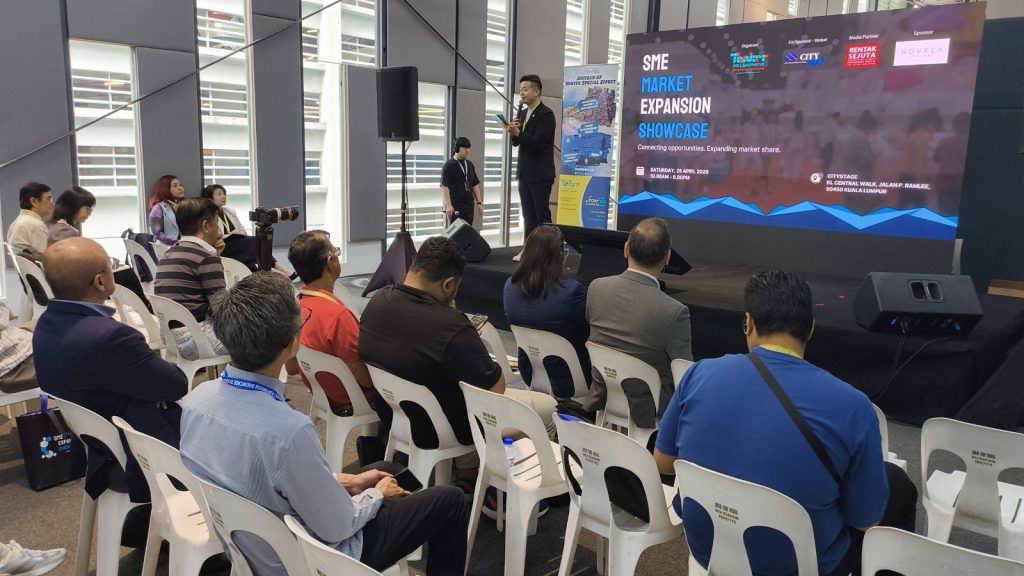
The inaugural SME Market Expansion Showcase, officially presented to the business community today, brought together more than 30 curated businesses and serious industry visitors at CityStage @ KL City Walk, located in the heart of Kuala Lumpur’s Golden Triangle. The showcase went beyond a traditional marketplace, serving as a dynamic business growth platform where brands gained exposure, conducted direct sales, and forged strategic partnerships. The programme focused on key areas such as direct customer engagement, on-the-spot sales opportunities, industry forum sessions, and networking with decision-makers, creating a high-energy environment designed to help participants learn, connect, and grow.
The one-day event attracted a strong turnout of SME owners, entrepreneurs, corporate professionals, decision-makers, as well as buyers and investors. Forum talks and panel discussions explored a wide range of topics, including market expansion strategies, the adoption of artificial intelligence for digital growth, access to financing and grants, smart scaling approaches, and the sharing of entrepreneurial success stories. The showcase also provided attendees with valuable direct access to founders and key decision-makers.
In her welcome address, Tanker Collaborative Director Janet New highlighted the vital role of SMEs as the backbone of the economy, noting that the showcase aimed to build a meaningful ecosystem where entrepreneurs could access funding insights, embrace digital growth, prioritise health, and establish strategic partnerships for sustainable success. She also elaborated on the event’s objectives and emphasised the importance of maximising both booth presence and forum participation. She added that the true value of the event lies in active engagement, encouraging exhibitors to present not just products but solutions and collaboration opportunities, while urging visitors to approach each interaction with purpose and curiosity to strengthen the overall business ecosystem.
A key highlight of the forum sessions was the focus on Environmental, Social and Governance (ESG) and its role in measuring a company’s sustainability, ethical impact, and operational risks. Leading the ESG discussion was Stacia Lim, Director for Corporate Governance, who provided in-depth insights into integrating ESG into SME strategies and explained why it is no longer optional. She also outlined practical frameworks for adoption and noted that Malaysia’s National Sustainability Reporting Framework and amended Bursa Malaysia Listing Requirements now encompass Scope 1, 2, and 3 emissions, with a phased mandatory implementation leading up to 1 January 2027, significantly reshaping obligations for suppliers and SMEs.
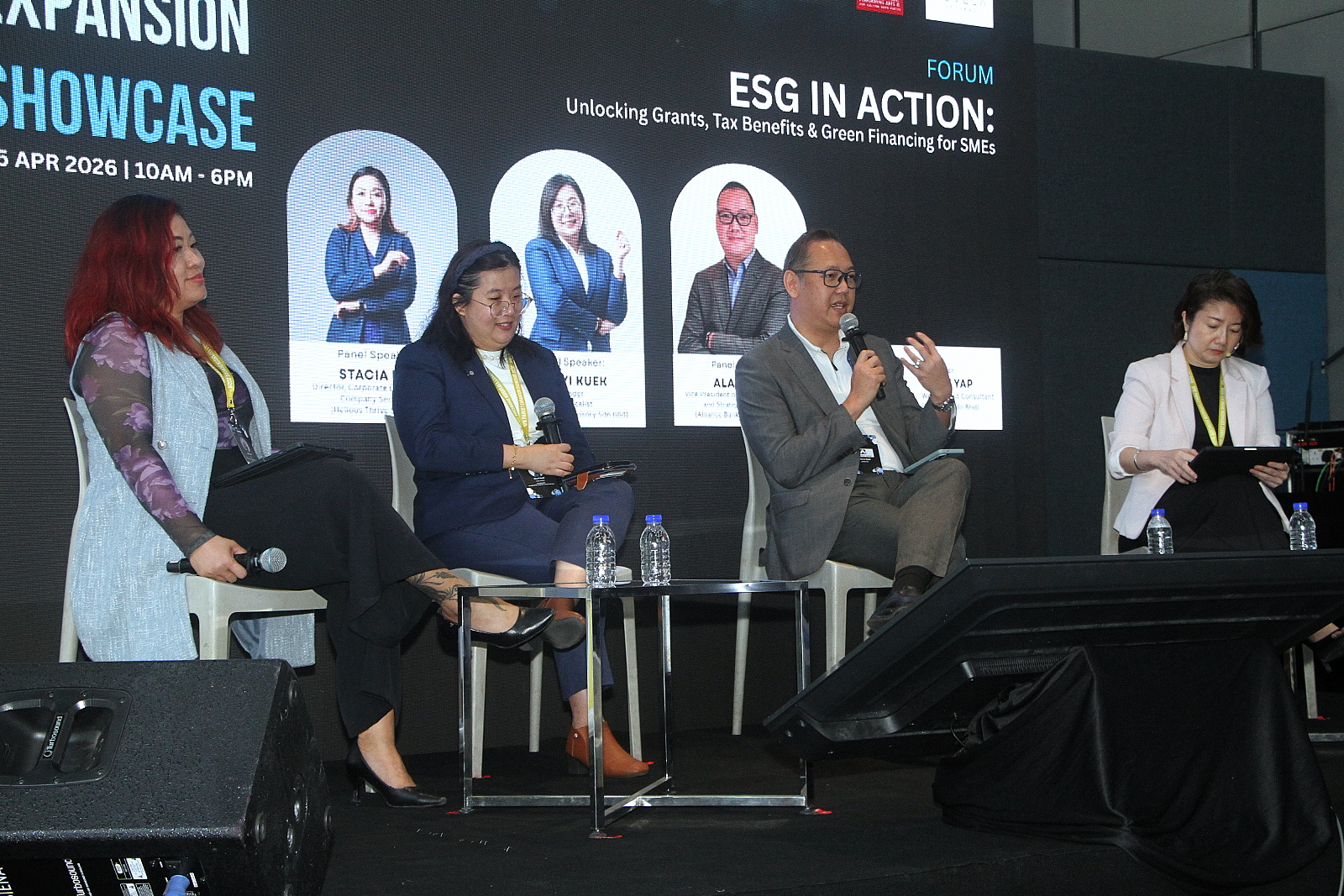
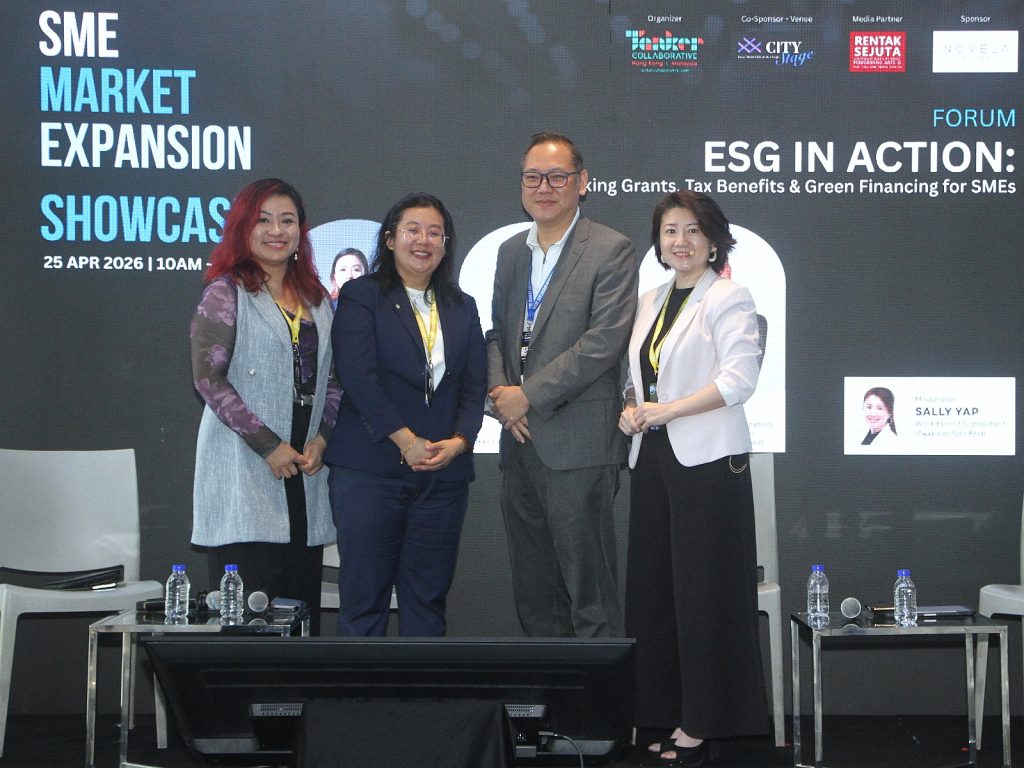
The discussion was further expanded in a panel session featuring Lim, Shu Yi Kuek, founder of KPL Corporate Advisory Sdn. Bhd., and Alan Chin, Vice President of Group Sustainability and Strategic Partnerships at Alliance Bank Malaysia Berhad, moderated by Sally Yap of PeakJob Sdn Bhd. The session explored ESG in action, including access to grants, tax incentives, compliance requirements, and green financing opportunities, while also sharing practical case studies and strategies for unlocking green loans. Lim emphasised that ESG adoption does not have to be costly and encouraged SMEs to start from their current capabilities, while Chin highlighted that sustainability is not merely a compliance exercise but a competitive advantage that can position SMEs ahead of their peers.
The discussion also touched on Malaysia’s new incentive framework, effective from 1 March 2026, which introduces a more targeted and outcome-based approach, with ESG practices as a key eligibility criterion. The framework will initially apply to the manufacturing sector, with the services sector timeline to be announced later, and offers incentives of up to 15 years.
Other forum sessions included a health talk by Nutrition Consultant Dr. JC Wong from JC Lifestyle Coaching, who shared insights on protecting heart health through proper dietary practices, including understanding good and bad fats, reducing harmful oils, adopting suitable cooking methods, and managing cholesterol naturally. He later joined Dr. Anandarajah Shanmugam, co-founder of Healthy Lifestyle Solutions, in a panel discussion that explored heart disease beyond conventional medical and diagnostic approaches.
Marketing influencer Kien Lim, founder of Attitude Ideology, presented on market expansion strategies for SMEs, covering entry into new markets, the use of digital channels, partnership models, and scaling without significant overheads. In the final panel session, Kien Lim was joined by Newspin Communication’s PR Director Marc Ng and Brand and Communication Consultant Clarence Koh to discuss content creation, public relations, social media, and the role of key opinion leaders in today’s attention economy. The session was moderated by Gina Woon, co-founder of Novela Boutique.
Throughout the day, exhibitors were also given the opportunity to deliver 90-second introductions of their businesses during networking sessions, enabling them to showcase their offerings and connect with potential partners and clients.
The event was organised by Tanker Collaborative Sdn Bhd, a dynamic event and business activation company with operations in Malaysia and Hong Kong. The company specialises in large-scale showcases, corporate events, and market expansion platforms, designing and executing high-impact experiences that connect brands, businesses, and communities. Through curated exhibitions and strategic collaborations, Tanker drives visibility, engagement, and measurable commercial outcomes, serving as a growth enabler for SMEs and enterprises seeking to expand their reach across regional markets. With a strong focus on execution excellence and results, the company continues to deliver seamless, purpose-driven events that transform ideas into impactful business opportunities.
Malaysia’s digital payments ecosystem is expanding at an unprecedented pace, but scale alone does not define strength. In 2025, the country recorded 18.4 billion e-payment transactions, reflecting a 25 per cent year-on-year increase, with each Malaysian conducting an average of 538 digital transactions. DuitNow QR volumes have also doubled to three billion, supported by close to three million merchant touchpoints nationwide.
While these figures reflect strong adoption, they also raise a more pressing question for the industry: whether trust is keeping pace as digital transactions become increasingly embedded in daily life. Reported fraud losses reached RM2.8 billion in 2025, highlighting the growing risks within an increasingly digital ecosystem. In the first quarter of the year alone, online fraud cases rose to 12,110, with total losses amounting to RM573 million. Although digital payments continue to scale rapidly, these figures point to a parallel reality in which confidence in the system is being tested in real time. This marks a clear inflection point, where the focus must shift from driving adoption at scale to strengthening trust and assurance at every stage of the transaction journey.
Trust in payments is often discussed in abstract terms, but for businesses on the ground it is grounded in three core elements: visibility, control, and protection. Visibility ensures merchants can track transactions in real time, control provides certainty over fund settlements and supports cash flow management, while protection offers reassurance that businesses are safeguarded when unexpected issues arise. When any of these elements are weakened, trust can quickly erode, particularly for smaller businesses operating on tight margins.
In practice, most payment failures do not occur at scale but at the edges of the system, where processes are fragmented and operational gaps are more likely to appear. For micro, small and medium enterprises (MSMEs), a delayed settlement or disputed transaction is not a minor inconvenience but a disruption to daily operations.
Bank Negara Malaysia has already recognised this shift in focus. The priority is no longer solely on expanding digital payments, but also on preserving trust within the ecosystem. Frameworks such as the Shared Electronic Fraud and Theft policy establish shared accountability between financial institutions and users, while infrastructure enhancements such as RENTAS+ and the adoption of ISO 20022 standards improve transparency and resilience across the payment system. However, regulation alone is not sufficient to build trust; it must be reinforced through consistent, real-world experiences at the merchant level.
Malaysia’s 1.2 million MSMEs sit at the centre of this transition. Unlike large enterprises, they often operate without extensive financial systems or dedicated risk management teams. Their exposure is immediate, and their tolerance for disruption is low. For these businesses, trust is not defined by policy or technical standards, but by whether payments are received as expected, whether transactions are transparent, and whether digitalisation simplifies rather than complicates operations. This is where the industry must move beyond enabling access and focus on delivering assurance.
From an operational perspective, addressing this gap requires rethinking the purpose of payment infrastructure. Direct connectivity to national payment rails is not merely a technical enhancement; it removes intermediary layers, enabling faster access to funds and greater visibility over cash flow. This is not just about speed, but about certainty, which is essential for business stability.
Similarly, consolidating multiple payment methods into a single platform or device goes beyond convenience. It reduces fragmentation, lowers operational risk, and ensures consistency in transaction outcomes. Unified terminals that support QR, card, and alternative payment methods within a single controlled environment reflect this approach. These are deliberate design choices aligned with how merchants operate, rather than how payment systems have traditionally been structured.
Trust must also extend beyond transactions to address broader business risks. Many MSMEs remain underinsured, often due to the complexity or perceived disconnect between traditional insurance products and day-to-day operations. Embedding protection directly into payment infrastructure provides a more practical solution, where coverage such as business interruption, liability, and asset protection becomes part of the tools merchants already use. By integrating these safeguards into the payment experience, barriers to adoption can be reduced while businesses are better protected against unforeseen disruptions. This reflects a broader shift in fintech, where value is created not only through functionality, but through relevance and integration into real business needs.
Paydibs, for example, has partnered with Great Eastern General Insurance to embed business protection directly into its payment terminals. Coverage for fire and flood damage, cash-in-transit loss, employer liability, and business disruption is bundled with the terminal merchants already use to accept digital payments. The principle is clear: businesses should not have to choose between digital growth and operational protection, as both should be built in by design.
Eighteen billion transactions in a single year is a significant milestone, and Malaysia has clearly demonstrated its ability to achieve digital payment scale. Bank Negara Malaysia’s priorities for 2026, which emphasise stronger fraud prevention, cross-sector collaboration, and inclusive adoption, further reinforce trust as a foundational pillar for continued progress.
In this environment, differentiation will no longer be defined by transaction volume or processing speed alone. It will be shaped by the ability to deliver systems that are resilient, transparent, and purpose-built to support businesses through both growth and uncertainty. Digitalisation accelerates when businesses have confidence in the systems they rely on, and that confidence is earned through consistent performance, clear visibility, and meaningful protection.
Dalam landskap pasaran tenaga global yang semakin tidak menentu akibat ketegangan geopolitik, bandar dan sektor persekitaran binaan kini perlu menyesuaikan diri dengan perubahan dinamik bekalan. Bangunan tidak lagi dilihat sebagai aset pasif, sebaliknya berperanan sebagai infrastruktur aktif yang mampu mengurangkan penggunaan tenaga, meningkatkan daya tahan serta mempercepat peralihan ke arah pembangunan rendah karbon.
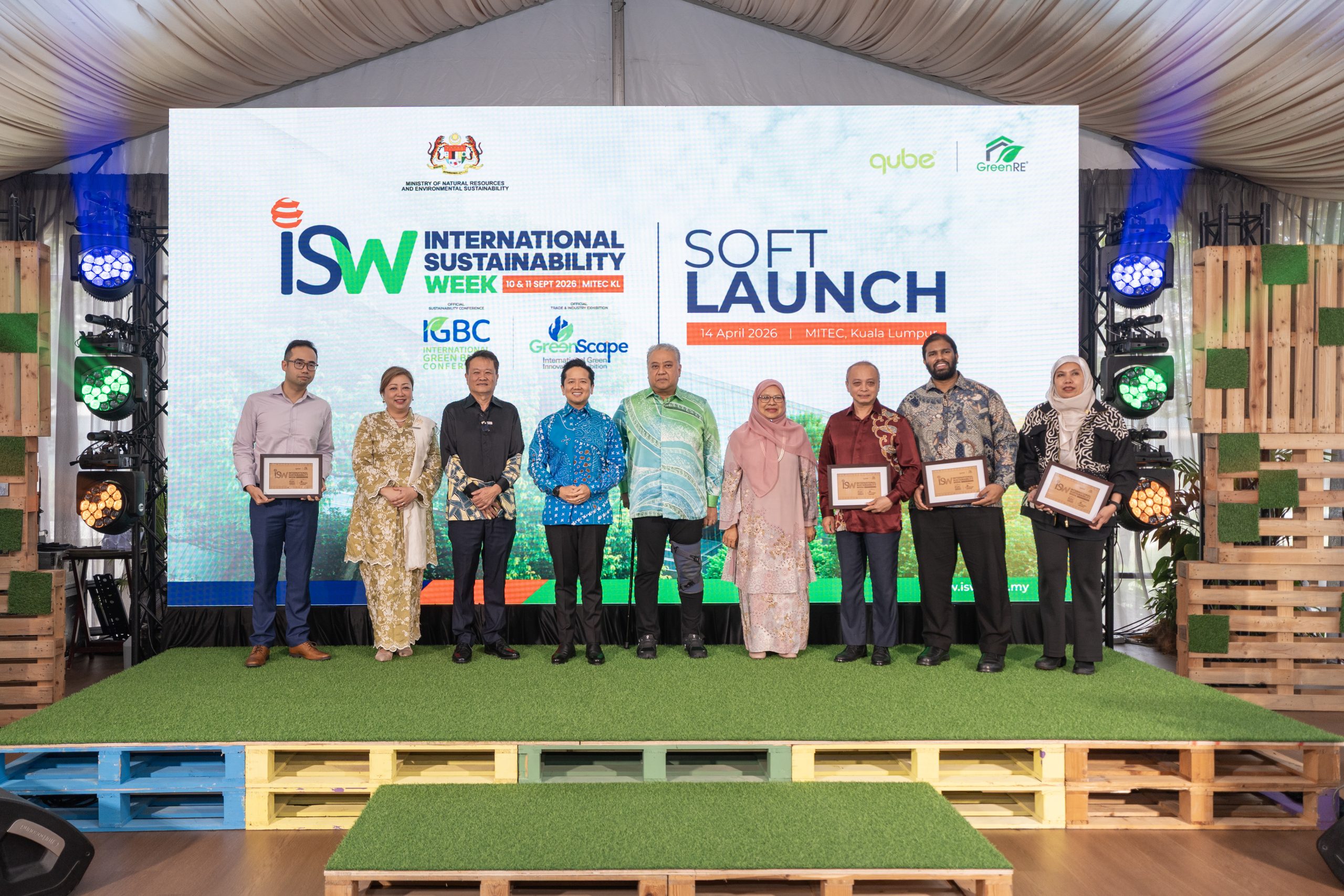
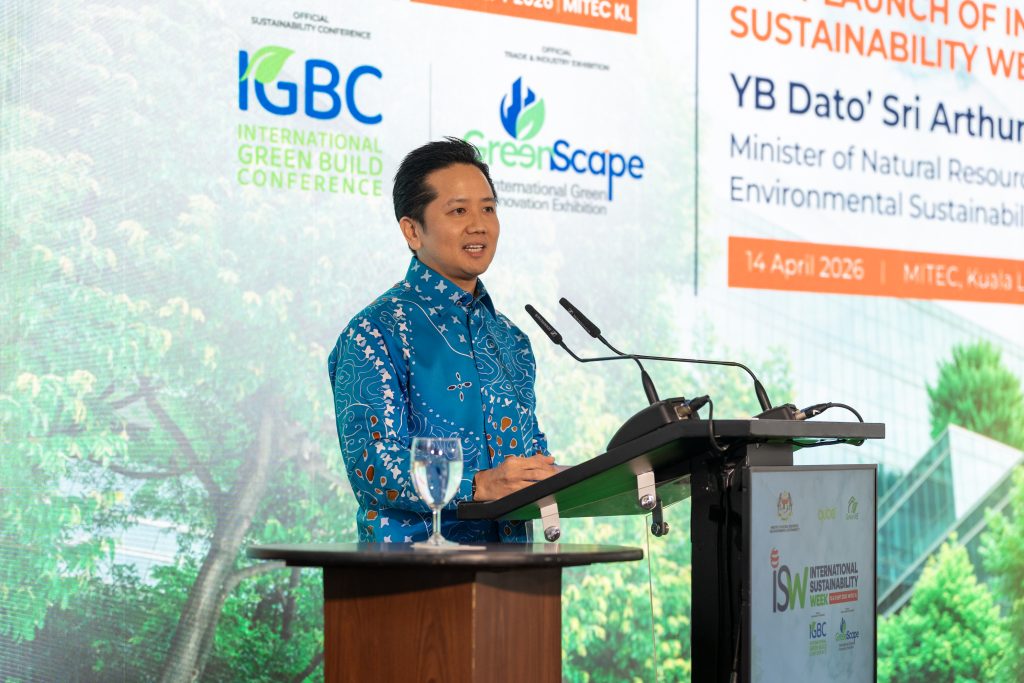
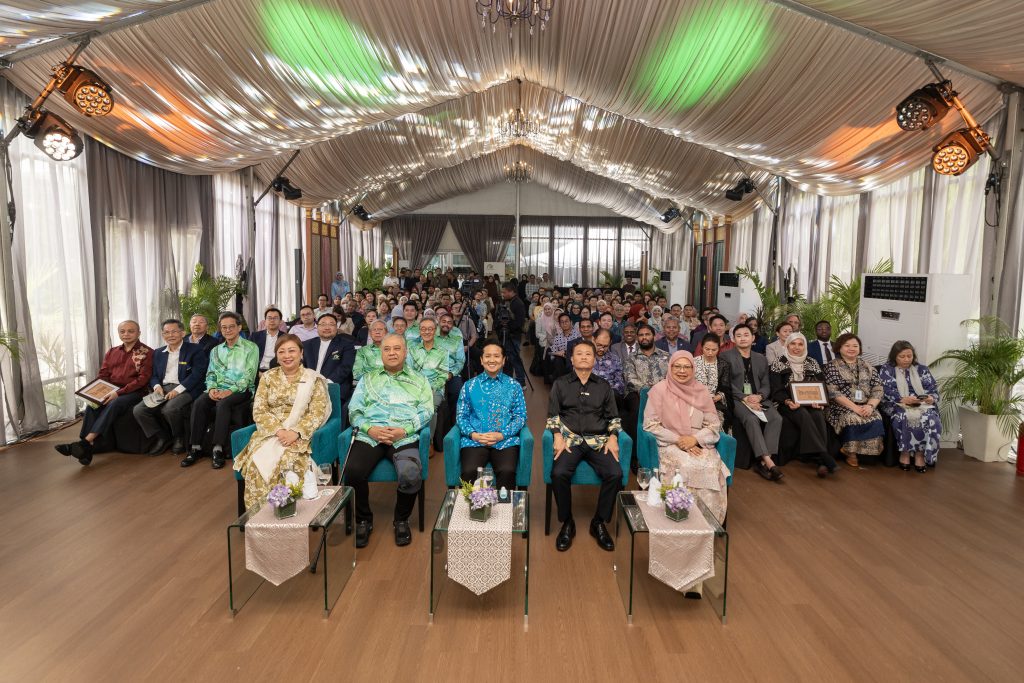
Seiring dengan keperluan ini, pelancaran awal International Sustainability Week (ISW) 2026 yang dirasmikan hari ini oleh Menteri Sumber Asli dan Kelestarian Alam, Dato’ Sri Arthur Joseph Kurup, menandakan peralihan penting dalam pendekatan terhadap kelestarian, iaitu daripada penekanan kepada aspirasi kemampanan kepada pelaksanaan yang lebih nyata dan berimpak.
ISW 2026 dianjurkan bersama oleh GreenRE Sdn Bhd, badan penarafan dan pensijilan hijau yang ditubuhkan oleh REHDA, bersama penganjur utama Qube Integrated Malaysia. Platform ini diwujudkan sebagai ekosistem berteraskan piawaian yang menghubungkan dasar, pensijilan dan penyelesaian industri dalam satu rangka kerja bersepadu, dengan penekanan terhadap pelaksanaan, prestasi yang boleh diukur serta hasil sebenar dalam sektor persekitaran binaan.
Menurut Dato’ Sri Arthur Joseph Kurup, peranan bangunan perlu berkembang seiring dengan cabaran semasa. Beliau berkata bahawa amalan lestari dan pembangunan bandar bersepadu akan menjadi asas kepada daya tahan serta pertumbuhan ekonomi pada masa hadapan. ISW 2026, jelas beliau, menyediakan platform berstruktur untuk menggerakkan pihak berkepentingan daripada perbincangan kepada pelaksanaan, sekali gus memastikan impak sebenar kelestarian dapat direalisasikan pada skala besar.
Pelancaran ini turut menyaksikan pencapaian penting industri apabila GreenRE melepasi 500 juta kaki persegi keluasan lantai kasar (GFA) yang diperakui, mencerminkan perkembangan pesat dalam pelaksanaan piawaian bangunan hijau dalam sektor hartanah Malaysia.
Pengerusi GreenRE, Datuk Seri FD Iskandar, berkata pencapaian tersebut mencerminkan kesiapsiagaan industri yang semakin kukuh. Menurut beliau, pensijilan menjadi penghubung antara tuntutan hijau dan realiti sebenar, dan pencapaian 500 juta kaki persegi ini menunjukkan skala piawaian yang disahkan kini memainkan peranan penting dalam membentuk persekitaran binaan yang selari dengan jangkaan pelabur, penyewa dan pengawal selia. Beliau turut menegaskan bahawa ini menandakan peralihan industri daripada komitmen kepada pelaksanaan, apabila kelestarian bukan lagi sekadar aspirasi tetapi telah diintegrasikan dalam reka bentuk, pembinaan dan operasi bangunan. Dalam keadaan tekanan tenaga dan iklim yang semakin meningkat, rangka kerja yang berwibawa dan boleh diukur seperti GreenRE menjadi semakin kritikal dalam memastikan kelestarian memberikan nilai sebenar, bukan sekadar niat.
Bersempena World Green Building Week, ISW 2026 mengukuhkan kedudukan Malaysia dalam gerakan global untuk mempercepat pembangunan bangunan lestari dan bandar mampan. Acara ini akan berlangsung dari 10 hingga 11 September 2026 di Pusat Perdagangan dan Pameran Antarabangsa Malaysia (MITEC), Kuala Lumpur.
ISW 2026 merupakan evolusi strategik kepada International Green Build Conference (IGBC) yang kini memasuki edisi keenam. Berteraskan peranan IGBC sebagai platform utama dialog dasar dan kepimpinan industri, ISW memperluaskan peranannya melalui integrasi GreenScape: International Green Innovation Exhibition, yang menggabungkan dasar, piawaian dan pelaksanaan dalam satu platform menyeluruh.
Bertemakan “From Certification to Transformation: Building a Net Zero Future Together,” IGBC akan memacu agenda dasar dan kepimpinan pemikiran, manakala GreenScape mengetengahkan teknologi sedia pelaksanaan serta model pembiayaan hijau yang menjadikan kelestarian lebih berdaya maju dari segi komersial. Secara keseluruhan, ISW 2026 menyediakan persekitaran bersepadu bagi menyelaraskan hala tuju dasar, piawaian dan keupayaan industri, sekali gus menyokong penyampaian hasil kelestarian yang boleh diukur dalam persekitaran binaan.
ISW 2026 dijangka menampilkan lebih 20 penceramah serantau dan antarabangsa, 100 pempamer inovasi serta 1,000 delegasi persidangan, dengan anggaran kehadiran sekitar 5,000 pengunjung dari dalam dan luar negara. Antara panel penceramah yang akan menyertai termasuk Nadia Verjee, Pengarah Eksekutif Expo City Dubai; Larry Ng, bekas Pengarah Kumpulan di Urban Redevelopment Authority Singapura; dan Joan Ko, Ketua Global Iklim dan Kelestarian Arup Australia. Mereka akan membincangkan topik seperti bandar sifar bersih, pembangunan bandar responsif iklim, tadbir urus dan piawaian, serta peranan data dan infrastruktur dalam menyampaikan hasil kelestarian yang boleh diukur.
Majlis pelancaran ini turut menyaksikan pertukaran Memorandum Kolaborasi (MoC) antara Qube Integrated Malaysia dan Malaysian Green Technology and Climate Change Corporation (MGTC) sebagai Rakan Sokongan. Kerjasama ini bertujuan menyelaraskan dua platform kemampanan utama negara, iaitu ISW 2026 dan IGEM, bagi memperluas penyertaan serta memperkukuh kerjasama antara pembuat dasar, industri dan penyedia penyelesaian.
Selain itu, REHDA Wilayah Persekutuan turut menyertai sebagai Rakan Strategik, manakala Lembaga Pembangunan Industri Pembinaan (CIDB) Malaysia sebagai Rakan Sokongan. Rakan lain yang diumumkan termasuk Rakan Hotel Rasmi iaitu Hyatt Regency Kuala Lumpur at KL Midtown, Imperial Lexis Kuala Lumpur dan Dorsett Hartamas Kuala Lumpur, serta Curio Pack sebagai Penghantar Kargo Rasmi dan EdgeProp sebagai Rakan Media Rasmi.
HONOR today officially unveiled a first look at the HONOR 600 Series, its latest flagship lineup. The reveal highlighted a striking Golden White finish alongside a new flagship design crafted using premium cold-carving techniques. Following its strategic repositioning into the flagship segment, the HONOR 600 Series is set to deliver industry-leading performance, including top-tier camera specifications. The devices will feature a powerful 200MP main camera, professional-grade CIPA 6.5 image stabilisation, and an impressive 120x zoom. HONOR also confirmed that Malaysia will be the first global market to debut the 600 Series, with the official launch date to be announced next week.
Building on the 200MP main camera introduced in the HONOR 400 Series, the HONOR 600 Series brings an upgraded flagship camera system engineered for ultra clarity, ensuring exceptional colour accuracy even in low-light conditions. Its enhanced telephoto capabilities now support up to 120x zoom, allowing users to capture fine details of architecture, wildlife, and portraits from a distance. The telephoto lens also achieves the industry’s highest CIPA 6.5 image stabilisation rating, effectively minimising motion blur and producing sharp, professional-grade images. In addition, the new AI Colour Engine intelligently processes photos to deliver more natural and true-to-life tones.
In terms of market performance, the N Series has demonstrated strong momentum in Southeast Asia, recording a 333% increase in sales for the HONOR 400 Series in 2025, according to a Counterpoint report. HONOR’s strategy has proven particularly successful in Malaysia, where the brand has rapidly expanded its smartphone presence and established itself as a leading choice among consumers. Throughout 2025, HONOR achieved significant sales growth in the country and is now the number one Android brand, driven largely by strong performance in the premium segment, particularly within the accessible flagship category.
For those interested in the HONOR 600 Series, HONOR Malaysia will unveil the full lineup along with more exclusive details tomorrow. Stay updated via HONOR Malaysia’s official Facebook page or visit https://www.honor.com/my/.
A new study by Milieu Insight, surveying 3,000 workers across six Southeast Asian markets—Singapore, Thailand, Malaysia, Indonesia, the Philippines, and Vietnam—reveals how employees perceive the risks associated with artificial intelligence (AI). Over-dependence on AI emerged as the top concern across all six markets, cited by 53% of respondents, ahead of privacy issues at 40% and job loss at 34%. While fears of job displacement remain notable, employees are increasingly questioning how AI might influence decision-making, critical thinking, and professional autonomy, highlighting unease over the potential erosion of human judgment and capabilities rather than the risk of outright replacement.
Respondents represented a variety of organisation types, led by private large companies with 200 or more employees, followed by local SMEs and multinational corporations. They also span a diverse range of industries, including engineering, manufacturing, retail, and information technology. Across markets, the concern over AI dependency is highest in Indonesia at 61%, followed by Thailand at 55%, the Philippines at 53%, Vietnam at 50%, and Malaysia and Singapore at 49% each. In contrast, concerns about job loss rank consistently lower, suggesting that workers are more focused on maintaining their independent capabilities than fearing replacement.
Looking ahead, 41% of respondents expect AI to assist them without replacing core tasks, using it to streamline routine work and improve efficiency. Over half (51%) said AI will help them save time on repetitive tasks, allowing them to focus on higher-value responsibilities. Meanwhile, 26% anticipate significant parts of their roles being automated, requiring adaptation to new methods, while 10% believe their jobs could be entirely replaced and another 10% expect AI to create new opportunities or responsibilities.
Overall sentiment toward AI is largely optimistic. Forty-one percent describe themselves as somewhat optimistic, believing the benefits outweigh the risks, and 13% are very optimistic. Vietnam (66%) and Thailand (58%) record the highest optimism, while Singapore shows the highest combined pessimism at 15%. This optimism across emerging Southeast Asian markets reflects expectations that AI will drive productivity, digital innovation, and new economic opportunities.
Despite strong interest in AI adoption, readiness gaps remain. Data security and privacy concerns are the most cited barrier, followed by lack of technical skills, cost, and employee resistance. Digital infrastructure gaps are more pronounced in Thailand and Indonesia than in Malaysia and Singapore, reflecting varying organisational maturity. Only a small proportion of respondents report that their organisations are fully prepared with strategies, resources, and training, while most describe themselves as only somewhat prepared. Active encouragement from employers to use AI is limited, ranging from 25% in Singapore to 38% in Vietnam.
This gap between enthusiasm for AI and organisational readiness highlights a broader challenge in the region. While businesses recognise AI’s potential, many are still in the early stages of building governance, training, and infrastructure needed to support widespread adoption. Sundip Chahal, Group CEO of Milieu Insight, explained that workers are not just worried about being replaced but are concerned about becoming overly reliant on AI at the expense of judgment, capability, and independent thinking. He emphasised that while the workforce is open to AI, organisations must focus on providing the right training, guardrails, and disciplines to ensure it is used responsibly and effectively.
Hot on the heels of its successful debut on the ACE Market of Bursa Malaysia, MSB Global Group Berhad (MSB Global) is laying the groundwork for a bold new phase of expansion. The Group has announced plans to invest in a new factory cum warehouse in Ulu Tiram, Johor Bahru, positioning itself as a manufacturer in the automotive lubricants and fluids space for the first time.
This strategic move is supported by RM4.97 million from the Group’s IPO proceeds, which raised a total of RM26.60 million. In addition to physical infrastructure, RM6.01 million is earmarked for the purchase of new machinery and equipment to jumpstart in-house production capacity.
In a notable step toward future-proofing its business, MSB Global is also entering the electric vehicle (EV) segment with the development of its first in-house branded EV charger, which is expected to launch in Q2 2025. The Group has allocated RM0.83 million toward this initiative, signaling a move beyond traditional aftermarket components and into green mobility solutions.
Managing Director Datuk Ow Kee Foo expressed strong confidence in the Group’s forward trajectory, stating, “The investments we’re making today are essential building blocks for tomorrow. Our new facility will not only enhance operational efficiency but also give us the agility to diversify our offerings. Entering the EV charging space is a milestone that aligns with global trends, and we are excited to take our first step into this evolving sector.”
With increasing demand for high-performance automotive fluids, as well as a surge in EV adoption, MSB Global’s expansion strategy is timely and well-aligned with market needs. The new developments will reinforce its standing as a dynamic player ready to shape the future of mobility in Malaysia and beyond.
KUALA LUMPUR, 17 February 2025 – Malaysia’s digital economy remains at the forefront of national growth, with an increasing focus on enhancing innovation, boosting productivity, and shaping new business models that transcend industries. The Malaysia Digital Economy Corporation (MDEC) is steadfast in its role as a catalyst for the country’s digital transformation.
CEO Anuar Fariz Fadzil highlighted that Malaysia’s strategic focus on digital initiatives, particularly Artificial Intelligence (AI) and talent development, has positioned the country as a regional leader in digital excellence. Public-private collaborations further bolster Malaysia’s role as a hub for groundbreaking technologies like AI and quantum computing, with transformative impacts across various sectors including manufacturing, finance, and services.
“We remain committed to reaching or surpassing the 25.5% digital economy contribution to GDP by the end of 2025,” Anuar said. “MDEC is actively advancing digital transformation, talent development, and technology adoption to help businesses evolve and thrive in the digital age.”
The digital sector continues to be a significant driver for the national economy, with foreign direct investments (FDIs) playing a pivotal role in shaping Malaysia’s economic landscape. Data centre investments reached an impressive RM86 billion in 2024, solidifying Malaysia as Southeast Asia’s leading data centre hub, with 77 data centres nationwide.
Malaysia’s economic growth saw a significant boost in 2024, with the country’s GDP growing by 5.1%, surpassing the 3.6% growth recorded in 2023. The growth was driven by strong export performance, substantial investment approvals, and progress in long-term public-private projects, including digital economy initiatives under the Digital Economy Blueprint and the New Industrial Master Plan 2030.
“The digital economy is an increasingly significant pillar of Malaysia’s recovery and prosperity,” Anuar emphasized. “The acceleration of digital investments is providing essential support for job creation, high-value employment, and national competitiveness.”
Under the Malaysia Digital (MD) initiative, approved digital investments for 2024 reached RM163.6 billion, exceeding 2023’s total by an extraordinary 250%. These investments have created over 48,000 new jobs, more than doubling the number of jobs created in the previous year, further demonstrating the growing role of the digital industry as a key driver of high-skilled employment.
Malaysia’s strategic location at the heart of ASEAN, coupled with its rich talent pool and expansive land resources, makes it an attractive destination for global investment. Top FDI inflows come from countries like Singapore, the United States, China, Australia, and India. Key sectors such as Global Business Services (RM139 billion), Information Technology (RM23 billion), and Creative Content (RM887 million) are all contributing to Malaysia’s vibrant digital economy and creating a significant number of high-value jobs.
MDEC’s emphasis on state-level digital development aims to enhance digital infrastructure, foster AI ecosystems, and drive digital transformation for SMEs across the nation. This state-focused strategy ensures that every region can contribute meaningfully to Malaysia’s overall digital economy goals.
“We will continue to attract world-class AI companies to set up operations in different states and promote the expansion of our homegrown tech champions into international markets,” Anuar said.
Anuar recently led a delegation to Johor, where he met with Chief Minister Datuk Onn Hafiz Ghazi and other state leaders to explore opportunities for collaboration. Anuar recognized Johor as a state with immense potential in the digital economy, owing to its strategic location and progressive policies that foster innovation and growth.
“Johor is on track to become a key regional hub for data centres, fintech, and digital content, supported by initiatives like the Johor-Singapore Special Economic Zone and the Iskandar Animation and Games Hub,” Anuar said. “These initiatives create an environment ripe for attracting international investments and generating high-value job opportunities.”
MDEC is set to return to Johor in the coming week to implement the plans discussed, ensuring that these digital economy initiatives are carried forward with actionable results.