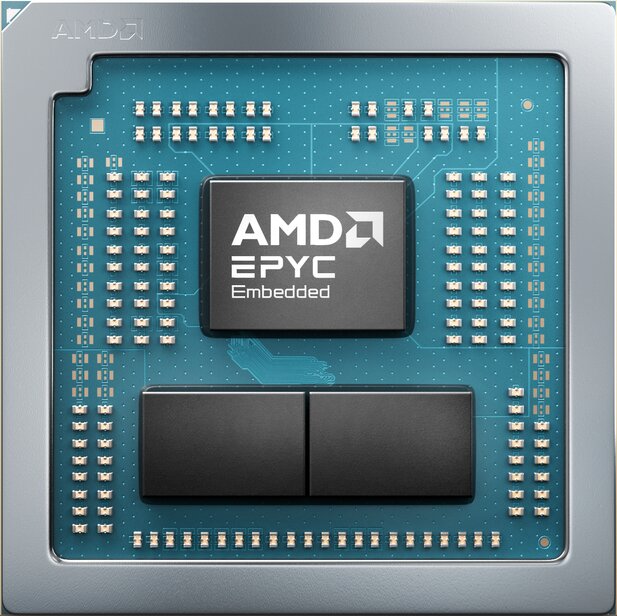
AMD has unveiled its latest EPYC Embedded™ 2005 Series processors, engineered to deliver high-performance, power-efficient computing in compact designs tailored for networking, storage, and industrial environments where power, space, and thermal constraints are critical. Built on the proven Zen 5 architecture, these processors feature up to 16 x86 cores, 64 MB of shared L3 cache, and configurable thermal design power (TDP) ranging from 45W to 75W, offering designers the flexibility to optimize for performance, energy efficiency, and thermal management. The processors come in a highly integrated 40mm × 40mm BGA package, 2.4 times smaller than comparable Intel Xeon solutions, enabling higher compute density, shorter electrical paths for better signal integrity, and improved thermal performance, making them ideal for 24/7 operation in constrained infrastructures.
The EPYC Embedded 2005 Series also delivers exceptional performance per watt, with up to 28 percent higher boost CPU frequency and 35 percent higher base CPU frequency compared to comparable Intel solutions, enabling superior performance density and lower total system cost. These processors are purpose-built for long-life deployments, supporting up to 10 years of continuous field operation, component availability, and technical assistance, alongside 15 years of software maintenance, ensuring stability and a strong return on investment. Advanced Reliability, Availability, and Serviceability (RAS) features detect, prevent, and correct errors to minimize downtime, while application-specific features such as BMC support, PCIe Hot Plug, and multi-SPI ROM provide additional design flexibility. Security is reinforced with AMD Infinity Guard technologies, including AMD Secure Processor, AMD Platform Secure Boot, and AMD Memory Guard, safeguarding data integrity and system reliability for mission-critical applications.
Connectivity and modularity are central to the EPYC Embedded 2005 Series, offering 28 lanes of PCIe Gen5 for high-speed I/O integration, including Ethernet NICs, FPGAs, and networking ASICs, while DDR5 memory support ensures higher memory bandwidth and future-proofing as DDR4 phases out. The processors are complemented by a robust open-source software ecosystem, with upstream support for Yocto, kernel drivers, and the Extended Development Kit (EDK II), simplifying integration and accelerating time to market. Targeting AI-driven workloads, modern networking switches, routers, DPU control planes, cold cloud storage, aerospace, and robotics applications, the AMD EPYC Embedded 2005 Series delivers the performance, energy efficiency, security, and longevity required for the next generation of embedded infrastructure systems.